The winepress of the wrath of God
Book of RevelationThe winepress of the wrath of God names Revelation’s severe harvest image for the final judgment of the unrepentant. In the commentary’s chronological reading, it is not an isolated metaphor: angels gather the earth’s ripe harvest, and that action is linked to the defeat of the forces assembled at Armageddon. Its movement from harvest to judgment makes the expression a hinge between Revelation’s visions of divine wrath and the account of Christ’s victory.
The image and its sequence
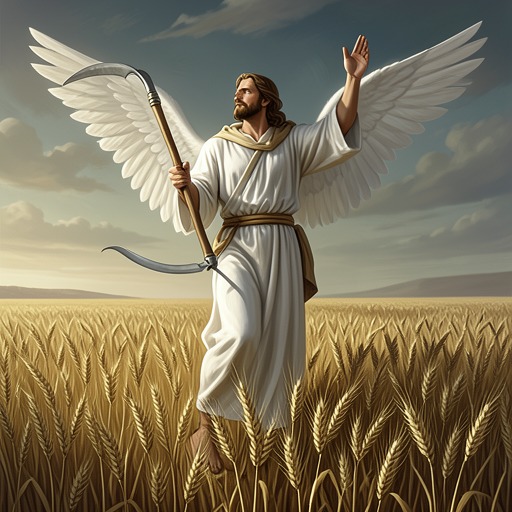
In Revelation 14:17–20, an angel comes from the heavenly temple carrying a sharp sickle. Another angel, coming from the altar and possessing authority over fire, calls for the ripe clusters of the earth’s vine to be gathered. The first angel swings the sickle, gathers the vine, and casts it into the great winepress of the wrath of God. The passage identifies the location as outside the city and gives the scale as 1,600 furlongs, with the image of the press’s outflow reaching the height of horses’ bridles. These details give the vision a defined agent, command, object, destination, and extent; the harvest is presented as an executed judgment, not merely a warning.
The vine and its ripe clusters provide the passage’s harvest figure, while the press conveys the severity and completeness of what follows. The sequence matters: the earth is gathered because its harvest is ripe, and the gathered vine is then placed in the press. The commentary reads this as the angels’ action against the unrepentant. It does not treat the sickle as an incidental object; it marks the transition from the announcement of judgment to its enactment.
Relation to Christ’s victory
The commentary connects the harvest vision with the later scene in which Christ rides forth as the Word of God. Christ’s robe is dipped in blood, his title is King of Kings and Lord of Lords, and the heavenly armies follow him. The sharp sword from his mouth and his rule over the nations establish him as the victorious judge; the text also describes him treading the winepress of the fierceness and wrath of Almighty God. The shared winepress image binds the angelic harvest in Revelation 14 to Christ’s judgment in Revelation 19.
The commentary makes this connection explicit: it describes the angels as warriors of God’s army sent to harvest the unrepentant and destroy the armies assembled for the battle of Armageddon. It then follows the gathering of the beast, the kings of the earth, and their armies against the rider and his army. The beast and the False Prophet are captured and cast alive into the Lake of Fire; the remaining forces are defeated. In this reading, the winepress is therefore both a figure of judgment on the earth’s harvest and part of the larger account of Christ’s triumph over the gathered opposition.
Placement in the commentary’s chronology
This interpretation depends on the book’s proposed sequence. The author argues that Revelation is not consistently arranged in chronological order and that some passages must be repositioned to make their relation to later events clear. Revelation 14’s meeting of the Lamb with the 144,000 Sealed from Israel is also read as occurring after Christ’s return, rather than before it. Within that reconstructed sequence, the harvest passage is brought into connection with the final battle and the judgment of those who oppose Christ.
The commentary’s wider timeline distinguishes the first half of the seven-year period from the period of God’s wrath that follows the rapture. It allows readers to call the first 3.5 years the Great Tribulation and the second 3.5 years the wrath of God, while insisting that the full period remains seven years. The winepress belongs to the climactic judgment phase in this framework: it expresses what the author understands as God’s action against the unrepentant after the transition to divine wrath. This placement is part of the commentary’s argument, rather than an uncontested chronological claim about Revelation.
The image within the larger judgment motif
The winepress also resonates with other judgment scenes in the commentary. At the seventh bowl, a great earthquake divides the great city, the cities of the nations fall, and Babylon is remembered before God to receive the cup of the wine of his fierce wrath. The press and the cup are distinct images, but both place the judgment of the nations within a recurring vocabulary of wine and divine anger. Alongside the bowl’s earthquake and the fall of cities, the winepress helps make the final judgment feel comprehensive in scope.
The author’s account ends the harvest-and-battle sequence not with the press alone but with Christ’s victory and the subsequent gathering of the 144,000 for worship before God’s throne. That transition supplies the image with its narrative consequence: judgment removes the gathered opposition, while the following scene turns to the Lamb and those associated with him. The winepress thus serves as a compact expression of the commentary’s central chronological and theological claim: Revelation’s harvest imagery belongs to the final confrontation and to the completion of God’s judgment.